This page has some suggestions for ways we can Make It Easier for Teachers of the Visually Impaired and schools to understand HOW a child with CVI sees. The information in vision reports from eye health specialists may be different from the information we need to help the child in a learning setting.
Working with QTVI and parents, we have developed a different structure which may Make It Easier to communicate the findings of an assessment.
It can be useful to think about HOW the vision system works in three separate ways
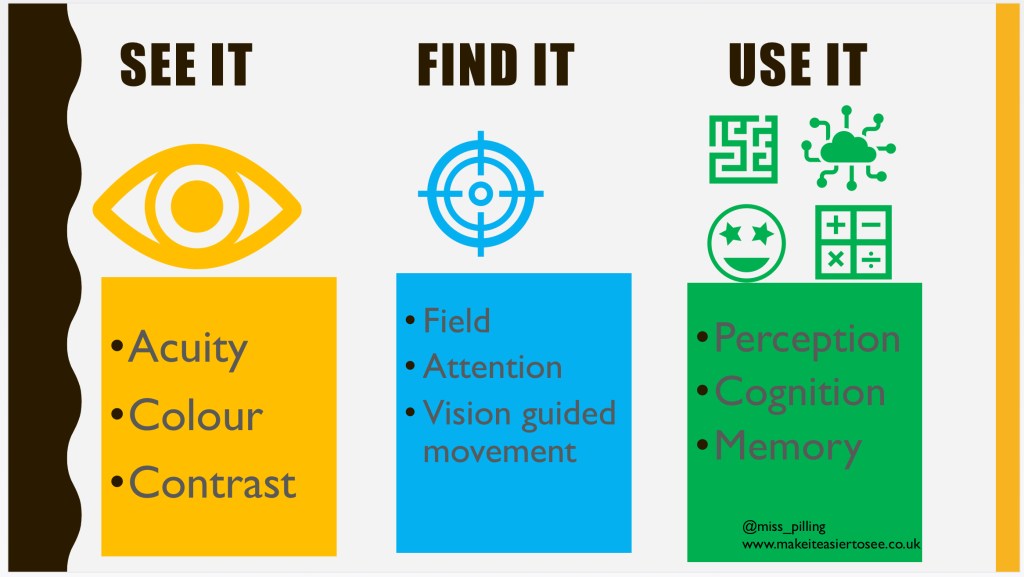
- SEE IT – can the EYE see the object, person, letter clearly. It is too small? Is it too blurry? Is it too pale?
- FIND IT – can the we see using our whole VISUAL FIELD or just in the centre, or to one side? can we keep our visual ATTENTION switched on for long enough periods? Do our EYE MUSCLES and BRAIN coordinate efficiently to look around to find things – do the eyes move smoothly and accurately.
- USE IT – once we have found the object, and a sharp, focused image is sent to the vision part of the brain, we need to PROCESS the visual information. WHAT is the object? Is it BIGGER or SMALLER than another object? Do I RECOGNISE this face or place? HOW FAR AWAY is it? Is it MOVING? This the most complex bit of vision – there are several parts of the brain which deal with this, and it is not well understood. It is the hardest area of visual function to test for.
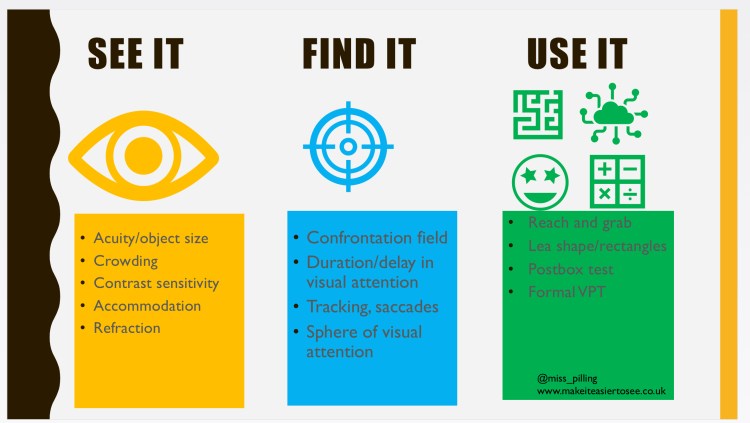
There are many different tests which can be used to build up a picture of the child’s vision. The choice of tests will depend on the child’s developmental abilities. There are some suggestions in the box below, and in more detail here.
Working with Daniel Downes, a QTVI in Salford, we have adapted this approach to be used as part of an assessment or report. It simplifies CVI for a parent or teacher, makes it easier for them to engage with conversations about vision and to learn what might help.
A copy of the See It Find It Use It report template is here
Think about CVI not as a spectrum, but as a patchwork quilt
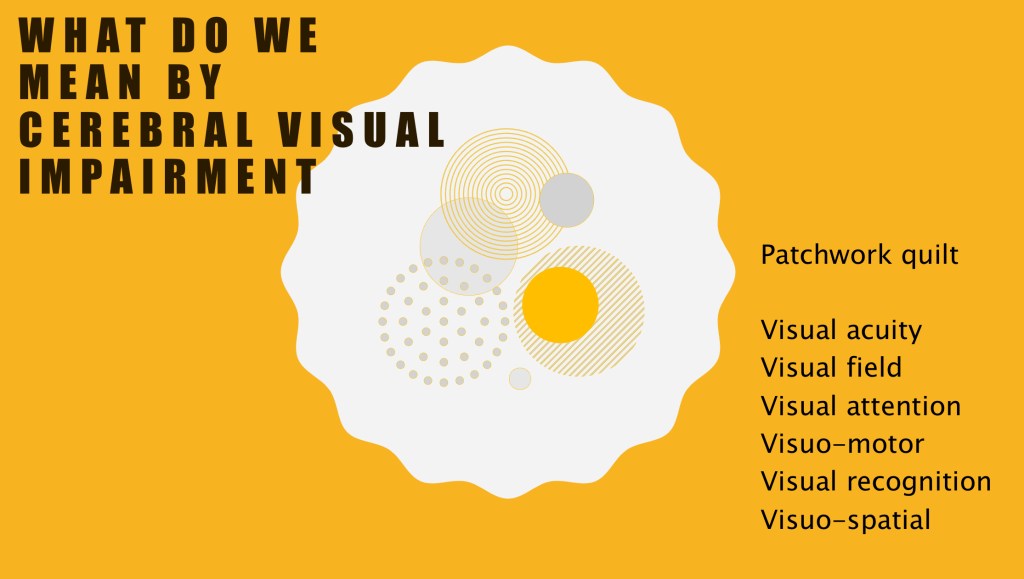
If we think about CVI not as a spectrum, but as a patchwork quilt, with each child having a unique combination of visual strengths and difficulties.Approach each child as a blank piece of paper, building up a picture of HOW they see. In special needs children, it can often be mostuseful to observe the child’s visual behaviours. Being curious about WHY a child tilts their head, gets close, bumps into large objects, chooses certain toys or TV programmes, finds meal times difficult, mixes up adults and so on, is key to understanding how to Make It Easier for them to see.
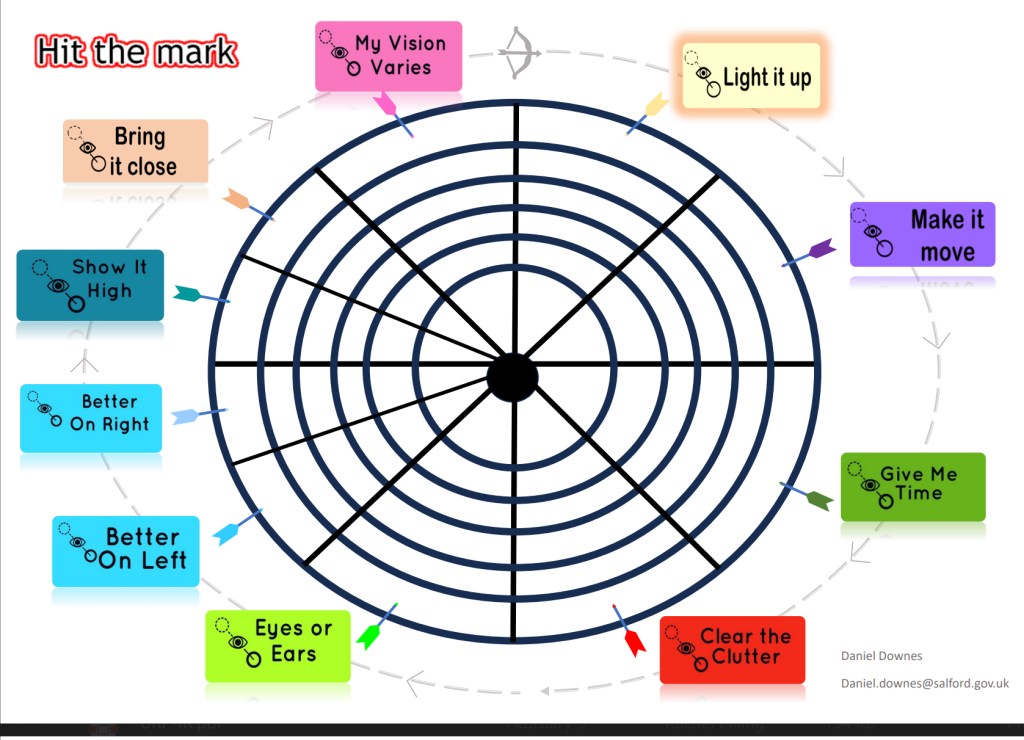
Hit the Mark
Once you’ve built up a picture of the child’s visual behaviours, you can test your findings out using ‘hit the mark”. The parent or class teacher can use this simple sheet to note down how often they find a strategy helps the child. You can download it here
How can we then use the information to Make It Easier for the child to see? This is perhaps the most important part of the assessment – turning our observations into simple strategies which every person who comes into contact with the child can use.
SEE IT

For children with reduced acuity/object size awareness or difficulty with reduced contrast big bright and bold objects are important.

When there is difficulty with seeing objects when they are crowded or close together, spacing things out or showing one at a time can improve visual function.

If a child needs glasses to keep their eyes in focus, its really important they wear them all the time. It might be the simplest way to Make It Easier to see.
FIND IT
Being aware of which side the child finds it easier to see objects can help with meal times, placement in the classroom and so on.

Many children find it difficult to see things in their lower visual field – placing items on a support above shoulder height can improve visual function.

It can sometimes take a few seconds for vision to switch on, or for the child’s motor response (ie turn head, eyes, reach and grab) to occur.

For most children, providing a clutter-free environment Makes It Easier to use visual search. Processing a smaller amount of information is likely to be less exhausting and promote visual attention.
USE IT

If the child has difficulty seeing moving objects it can help a lot to stand still, or hold objects in one position.

Using more than one sense at a time can be very hard work. It’s common to be overwhelmed by too much sensory input.

Face blindness is a less common feature of CVI. Using other cues to help a child recognise people, or understand their facial expressions, can help with social development.
 Make It Easier To See